Local Pickup Benefit
Enjoy up to $100 off when you pick up your order at our studio.


A piece of moss art is mostly the things you cannot see. The board behind it. The adhesive holding it. The joinery at the corners, and the hardware on the back.
Most pages on the subject describe the moss and stop there, which leaves out the half of the piece that decides whether it still looks right in eight years.
This is what a preserved moss piece is actually made of, including the parts you never see.
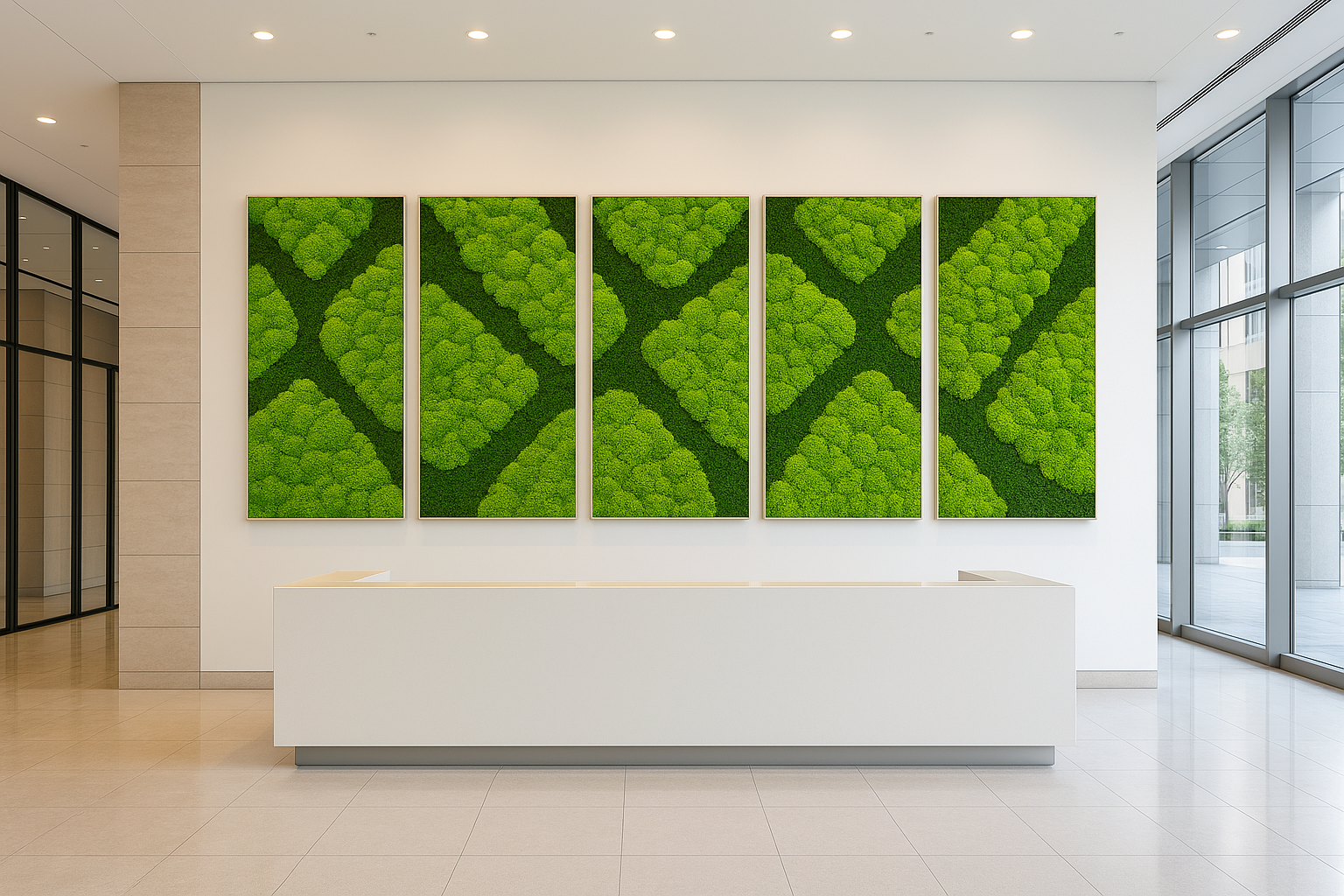
A preserved moss piece is made from real moss whose moisture has been replaced with a glycerin-based solution, layered by hand onto a rigid backing board inside a built frame. The moss determines how it looks. The backing board, adhesive, joinery and mounting hardware determine how long it keeps looking that way.
Most finished pieces combine several, because each one does something the others cannot.
| Variety | What it is | Depth | Role in a piece |
|---|---|---|---|
| Mood moss | Dicranum scoparium | 2–3″ | Swept plumes; creates topography and shadow |
| Pillow moss | Leucobryum glaucum | 2–4″ | Tight domes; the sculptural relief |
| Reindeer moss | Cladonia rangiferina — a lichen | 1.5–2.5″ | Branching texture; carries color |
| Sheet moss | Hypnum cupressiforme | under 1″ | Flat foundation and background |
| Hair moss | Polytrichum | 1–2″ | Upright, bristly; vertical contrast |
Two of those are not mosses at all. Reindeer moss is a lichen — a partnership between a fungus and an alga — which is why it takes dye so evenly and why almost every vividly colored moss wall is built on it. Spanish moss, used for draping, is a bromeliad: an air plant, more closely related to a pineapple than to anything else on this list.
More on how the two main varieties differ in our guide to mood moss vs reindeer moss.
The plant's own moisture is replaced with a glycerin-based solution. Commercial processes immerse or spray, then add an anti-mildew treatment, usually a dye, and in some cases a fire-retardant treatment. Drying takes a couple of weeks.
The plant is dead. Its chlorophyll no longer functions, which is why nearly all commercial preserved moss is dyed — without it the color would be a dull olive-brown. It will not grow, root, spread, or photosynthesize. We cover this in more detail in is preserved moss alive.
One consequence matters for owners: glycerin is hygroscopic, meaning it attracts and holds moisture from the air. That is why a piece feels firmer in dry winter air and softer in humid weather, and why water is the fastest way to ruin one — it re-mobilises the preservation solution.
Worth saying plainly, because a lot of moss marketing claims otherwise.
Preserved moss does not purify air, produce oxygen, absorb carbon dioxide, or filter VOCs. Those are metabolic functions, and preservation stops metabolism. It also does not meaningfully regulate a room's humidity — it responds to the room, not the other way around.
What it genuinely offers is real botanical texture with no watering, no light requirement, no soil, no pollen and no fungus gnats. That is enough of an argument without inventing a second one.
This is the most consequential component you will never see.
When someone describes a piece as having warped, the backing board is almost always the reason. Thin MDF or a cardboard-backed frame is the single clearest tell on an inexpensive import.
We build ours from solid hardwood in the studio, which is a choice about longevity rather than appearance. The alternatives are finger-jointed and veneered stock, or an MDF core wrapped in printed woodgrain — both look fine on day one and both behave differently over a decade.
Joinery is the other tell. Mitred corners that are splined or keyed and glued will stay closed; corners held with staples tend to open slightly as the wood moves with the seasons.
Standard hot melt glue runs hot enough to scorch fine moss tips, which is visible up close as browned, crisped edges on mood moss plumes. Low-temperature adhesive avoids it.
The more common failure is simply using too much. Glue applied onto the moss rather than into the substrate mats the fibers down and kills the loft — and it is permanent, because there is no way to lift it back out afterwards. A piece that looks slightly flat and slightly shiny in raking light has usually been over-glued.
For anything large or heavy, a French cleat is the correct answer: two interlocking bevels, one on the piece and one fixed into studs. It spreads the load across the wall, self-levels across the width, holds the piece flush, and cannot be knocked off a hook.
Sawtooth hangers and a single D-ring on wire are what most inexpensive pieces ship with, and they are the reason large artwork hangs crooked or comes off the wall. Our guide to installing artwork with a French cleat covers the method.
| Budget piece | Well-made piece | |
|---|---|---|
| Backing | Thin MDF or card | Rigid plywood |
| Frame | Wrapped MDF, stapled corners | Solid hardwood, splined mitres |
| Moss | One variety, uniform | Several layered for depth |
| Adhesive | Heavy, hot, visible | Minimal, into the substrate |
| Hardware | Sawtooth hanger | French cleat |
| Dye | Bleeds, fades faster | Stable, handled dry |
Published figures range widely — two to eight years for home-preserved moss, ten or more for well-made commercial work in the right conditions. The range is that wide because it is driven almost entirely by three things: direct sunlight, humidity outside roughly 40–60%, and build quality.
Claims of a "lifetime" are not supported by anything. More on what actually shortens it in how long preserved moss lasts.
Yes. It is real moss that has been stabilized rather than manufactured. The texture and color variation come from the original plant. It is no longer living.
No. Reindeer moss is a lichen, a partnership between a fungus and an alga. Spanish moss is not a moss either — it is a bromeliad, an air plant.
Almost all commercial preserved moss is dyed, because preservation stops chlorophyll from functioning. Good dye is stable for years indoors. Prolonged direct sunlight fades it, the same way sun fades textiles and prints.
Mostly the parts you cannot see: the backing board, the frame stock and joinery, how much moss is layered on, and the mounting hardware. The moss itself is a smaller share of the cost than people expect.
A rigid plywood backing board inside the frame. Inexpensive pieces typically use thin MDF or card, which is where warping comes from.
No. It is not alive, so it does not photosynthesize, produce oxygen, absorb carbon dioxide or filter VOCs. Any claim otherwise is incorrect.
Most of what is described here is easier to judge in person than from a photograph — the depth of the layering, the weight of the frame, the finish on the back. Browse our moss frames, walls and panels, see how we build it. For a piece made to your wall, start with custom moss artwork.
The Moss Shop specializes in handcrafted preserved moss artwork for homes and businesses.