Local Pickup Benefit
Enjoy up to $100 off when you pick up your order at our studio.


Some rooms are finished and still feel unresolved. Everything is in its place, the proportions are right, and the wall above the sofa is quietly holding something a size too small for it.
That is the moment people go looking for a statement piece — a phrase used constantly and defined almost never. The route to it is usually the same: a large blank wall, a piece of art that looks lost on it, and a suspicion that the answer is simply bigger.
Bigger is most of the answer. It is not all of it.
A statement piece is a single work large and visually dominant enough to be a room's focal point — the thing the eye goes to first and keeps returning to. Scale is necessary but not sufficient; it also needs enough contrast against the wall, in color or texture, to hold attention. A large beige canvas on a beige wall is big, not a statement.
Scale. The measurable part, and the one most people get wrong.
Contrast. Against the wall behind it. This can be color, but it does not have to be.
Dimension. The axis almost nobody discusses, because most articles on this topic are written by companies selling flat prints. A textured piece casts its own shadows, so it changes through the day and as you move past it. A flat print looks identical from every angle at every hour. In a large open-plan room, where a piece is read from fifteen feet rather than six, dimension does more work than color.
Art should span roughly two-thirds the width of the furniture beneath it. The accepted range is 50 to 75%.
| Furniture below | Width | Art width |
|---|---|---|
| Console | 48″ | ~32″ |
| Loveseat / queen bed | 60″ | ~40″ |
| Standard sofa | 72″ | ~48″ |
| King bed | 76″ | ~50″ |
| Large sofa | 84″ | ~56″ |
| Sectional | 90″ | ~60″ |
On a wall with no furniture beneath it, the reference changes: aim for 60 to 75% of the usable wall width, leaving clear margin either side.
Err large. Undersized art reads as accidental. Slightly oversized reads as intentional. Given the choice, go up. Our wall art size guide works through this room by room.
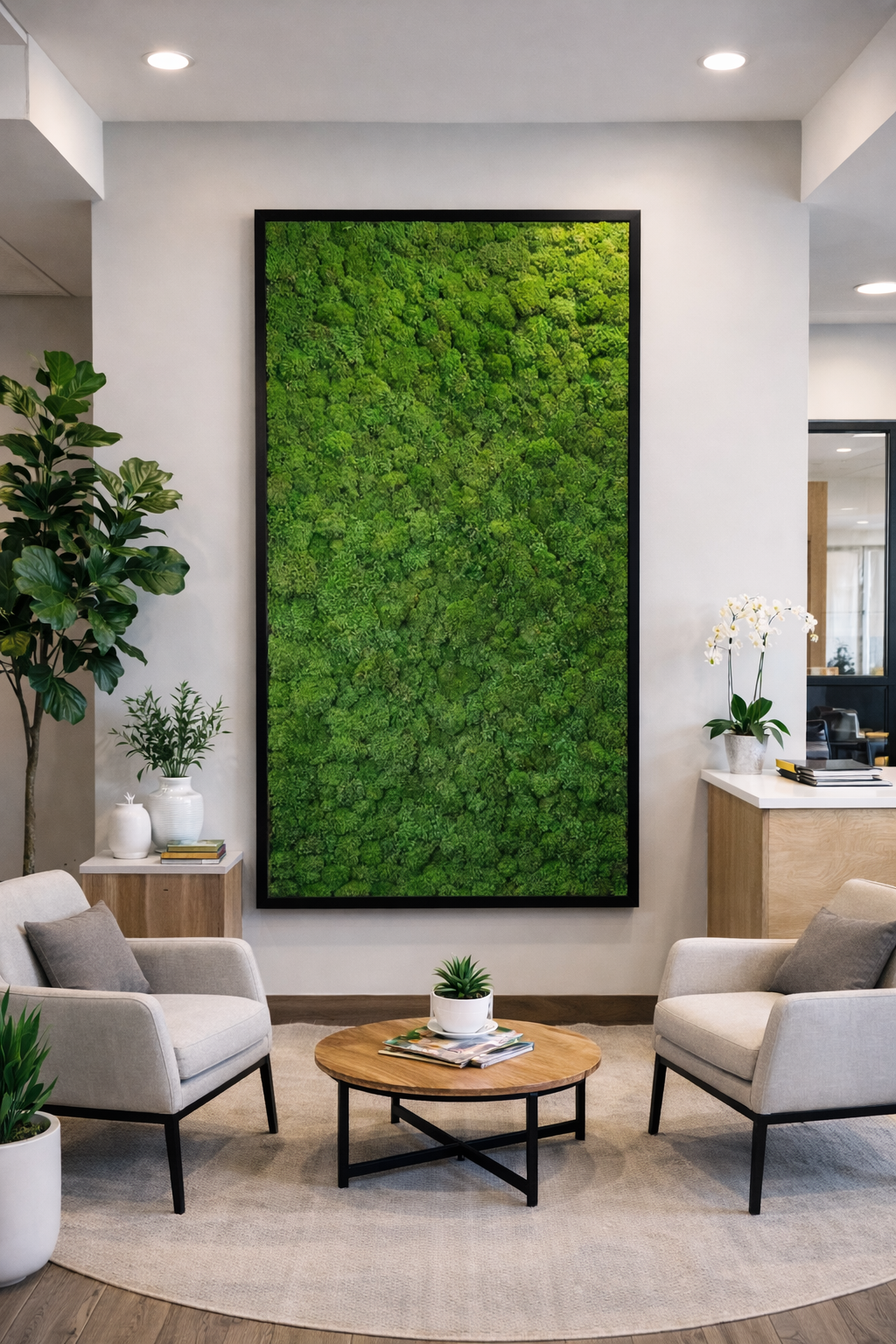
Center the piece at 57 to 60 inches from the floor. That is the gallery standard and it approximates average eye level.
Over furniture, leave 6 to 8 inches between the top of the furniture and the bottom of the frame, so the two read as one composition.
Adjust for how the room is used. In a dining room or a low-seated lounge, dropping the center a few inches reads better because everyone is seated. In an entry or stairwell, hold the standard or go slightly higher. More detail in how high to hang wall art.
The real difference is not decorative, it is cognitive. A statement piece gives the eye one place to land. A gallery wall gives it many, and creates visual activity.
| Use a statement piece | Use a gallery wall |
|---|---|
| Rooms meant to feel calm | Hallways, stairwells, circulation |
| Rooms already visually busy | Narrow walls a large piece cannot fit |
| Open-plan spaces needing an anchor | Collections with personal meaning |
| Large uninterrupted walls | Walls people move past rather than sit in front of |
If you do go with a grouping: 2 to 3 inches between frames, and the combined footprint including gaps should still land at about two-thirds of the furniture width. A gallery wall is a statement piece assembled from parts, and it is harder to get right, not easier.
If the room already has a strong focal point — a fireplace, a large window with a view, feature millwork — a second statement competes with the first and both lose. Pick one.
Very small rooms are the other case: a dominant piece crowds rather than anchors. So are walls that exist mainly to be walked past.
Our guide to designing a focal point goes further into how a room's hierarchy works.
Lighting is part of the piece, and it is the step most people skip after spending real money on the artwork itself.
Flat overhead light washes a piece out. It removes shadow, which removes the sense of depth, and a textured work loses most of what makes it worth looking at. Directional light from above and slightly in front — a picture light, adjustable track, or a wall washer set at an angle — rakes across the surface and brings the relief back.
For interior designers specifying a moss piece, this is worth settling at the lighting plan stage rather than afterwards, because the difference between a piece lit at an angle and one lit flat is larger than most renderings suggest. In a commercial setting, a single adjustable fixture aimed at the installation usually does more for the room than another two feet of artwork.
Scale enough to dominate the wall, contrast enough to hold attention against it, and ideally dimension. A large piece that blends into the wall color is not a statement.
Roughly two-thirds the width of the furniture beneath it, within a 50 to 75% range. On an empty wall, 60 to 75% of the usable wall width.
Centered 57 to 60 inches from the floor, with 6 to 8 inches of clearance above any furniture below.
Not in the same sightline. Two competing focal points weaken each other. A large open-plan space can carry one per zone.
Sometimes, but carefully. In a small room a dominant piece can crowd rather than anchor. Scale to the wall, not to the ambition.
No. Contrast can come from texture and depth rather than color — which is often the better choice in a room meant to feel calm.
Preserved moss works as a statement piece for a specific reason: the depth is physical, so it reads from across a room and changes as the light moves. Browse our moss frames, walls and panels, use the size finder, or visualize a piece on your own wall before you commit. For a piece built to your dimensions, see custom moss artwork.
The Moss Shop specializes in handcrafted preserved moss artwork for homes and businesses.