Local Pickup Benefit
Enjoy up to $100 off when you pick up your order at our studio.


A new house is a collection of surfaces waiting to be resolved. Bare walls. Clear counters. A dining table that has not yet held anything.
It is a generous condition, and an unfinished one. Which is why the housewarming gift is such a difficult object to choose — the room does not want for things. It wants for depth.
The candle and the bottle of wine are gracious instincts. They are also, invariably, what several other guests have chosen.
A housewarming gift works when it has a surface waiting for it, asks nothing of the person, and is not so personalized that it can only live in one house. Spend according to how close you are rather than what the house cost — $20 to $50 for a coworker or neighbor, $50 to $100 for a good friend, more for family.
Walk into a house a month after the move and most of it has been decided. The sofa has found its wall. The rugs are down. There is a lamp in the corner that was clearly chosen rather than inherited.
What is missing is rarely another object. It is texture — a room of flat finishes and clean lines, where nothing catches the light or holds a shadow. New houses are smooth. That is what makes them feel new, and also what makes them feel briefly uninhabited.
The gifts that succeed tend to supply that missing quality rather than another thing to be placed.
The data here is not flattering. Surveys of around 2,000 US adults find that 53% of people receive at least one unwanted gift, averaging about $72 each. Roughly a third are regifted, a third exchanged, and about a third simply kept anyway.
Household items land second on that unwanted list at 33%, behind only clothing.
So the caution is earned. Decor is a category where a near-miss becomes a permanent resident, and the pieces that work usually do several specific things.
The research on gift-giving points consistently at one habit.
Givers shop for impressiveness. Recipients are considering whether they will actually use the thing. It is the difference between the beautiful pen and the pen that writes well, and it explains a great deal of what sits unused in cupboards.
There is a related finding: people often avoid giving the thing specifically asked for, on the theory that a surprise signals more thought. It rarely does. Most people would prefer the thing they mentioned.
And a third worth knowing — we lean toward experiences for those closest to us, though objects frequently hold up better over time. The dinner is over by Sunday. The object remains in the room.
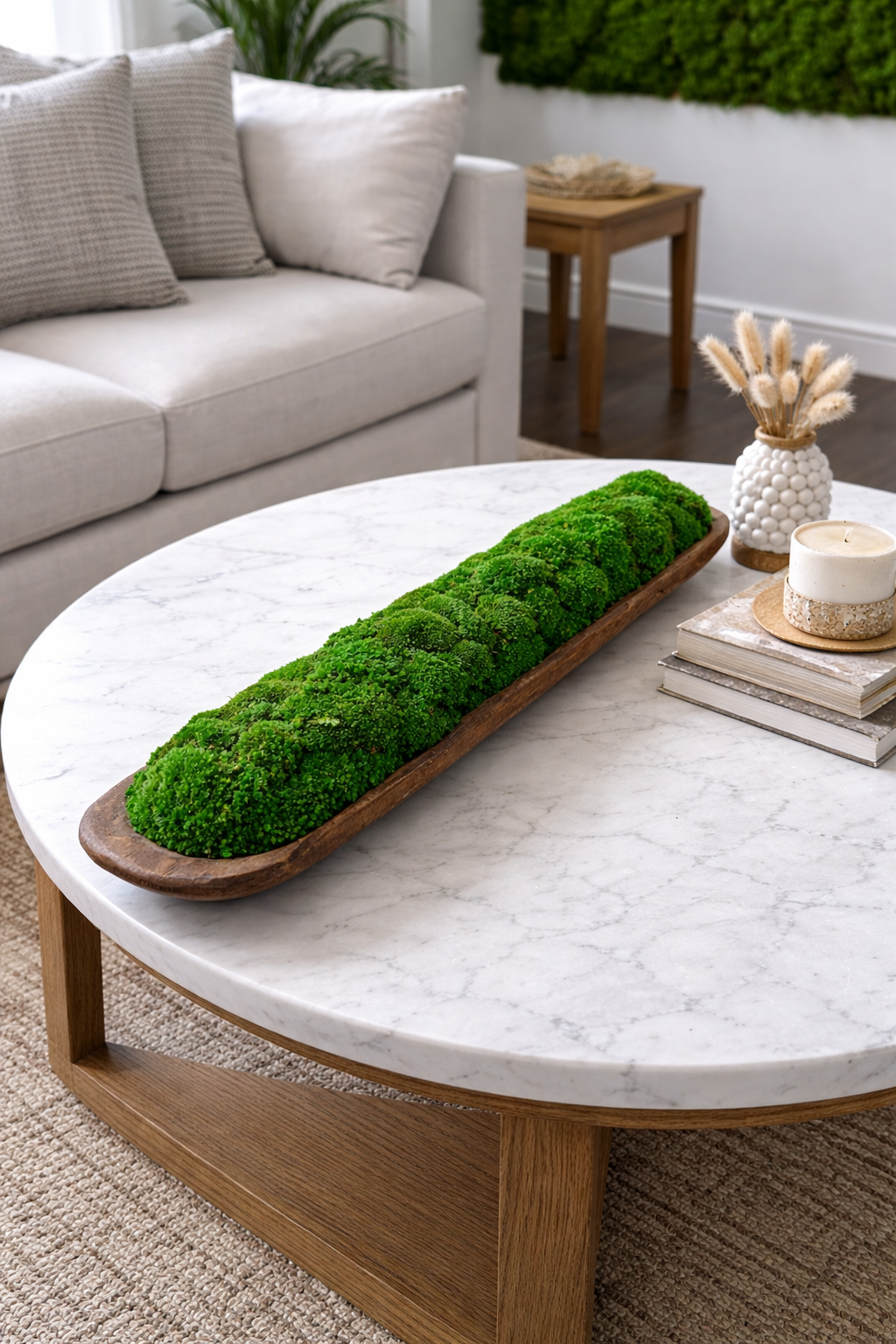
Every home has a table. Almost none of them have anything upon it.
It is the last surface to be considered. The walls are attended to, the seating is resolved, and the center of the table remains empty until the evening it matters — which is always the first evening someone is invited.
A centerpiece is a modest thing to give a room, and it alters the one surface around which everyone gathers. Preserved moss, in particular, introduces texture and shadow into an interior otherwise composed of flat finishes and clean lines.
Our piece on the moss bowl centerpiece trend covers how the category took hold.
A plant is the default thoughtful gift, and it is also a small obligation in a pot.
It arrives with someone living out of boxes, who has not found the good scissors and does not yet know which window gets afternoon light. If it does not survive — and in that month it might not — they feel bad about something you gave them.
Preserved moss offers the same green presence without the upkeep. It is real moss, stabilized so that it holds its color and softness for years indoors. No water, no light, no soil, no pollen.
It is not alive, which is worth saying plainly because the opposite is claimed often. It does not purify air or produce oxygen; preservation ends all of that. What it does is hold genuine botanical texture in a room indefinitely, which is the part that matters on a table.
| Budget | Who it suits | What is realistic |
|---|---|---|
| Under $50 | Coworker, neighbor, party guest | Consumables — candle and wine territory |
| $50–150 | A good friend | An actual object becomes possible |
| $150–400 | Close friend, sibling, client | Centerpieces and smaller framed work |
| $400+ | Family, or several people together | Something that anchors a room |
The principle underneath it: spend tracks the relationship, not the property value. An expensive gift from a casual acquaintance is uncomfortable for everyone, which is its own kind of miss.
Each piece leaves our Chicago studio hand-laid — the moss placed cluster by cluster, the frame built in our own shop from solid maple or solid walnut. Three finishes: black, painted over solid maple; natural light brown, the maple left to show its own grain; and walnut brown, which is simply the walnut. No two pieces are identical, because the material does not arrive identical.
That is also the practical note on timing. Home sales bottom out in January and peak around June, so housewarming season runs roughly May through September, with a second wave in December when a new house meets the holidays. A gift that must exist by Friday is a different conversation from one that can arrive in three weeks.
Around $20 to $50 for a coworker or neighbor, $50 to $100 for a close friend, and more for family. Scale it to the relationship rather than to the value of the house.
Look for a category they would never buy for themselves rather than a nicer version of something they own. A table centerpiece is the gap in most otherwise finished homes.
Anything monogrammed or heavily personalized, anything that needs looking after, and anything with no obvious place to sit. Some traditions also avoid giving clocks.
Not at all. Consumables are the convention because they are safe, not because anyone expects them.
Preserved botanicals, ceramics, glass and framed work. Preserved moss in particular gives a room greenery with no watering, light or soil.
No. One gift is plenty. A bottle for the evening is a courtesy rather than a second present.
Everything we make is built by hand in our Chicago studio, frames included. If you are buying against a date, our ready-to-ship frames and bowls skip the build time. Otherwise the moss bowl centerpieces are the natural place to begin, and the pieces ordered most often are a good second look.
The Moss Shop specializes in handcrafted preserved moss artwork for homes and businesses.